GST Rate Changes Announced: Relief for Farmers and Patients, Higher Tax on Luxury & Sin Goods
At the GST Council meeting chaired by Finance Minister Nirmala Sitharaman on September 3, India approved a landmark overhaul of the Goods and Services Tax system—dubbed GST 2.0—effective September 22, 2025, the first day of Navratri .
🛒 What’s Getting Cheaper
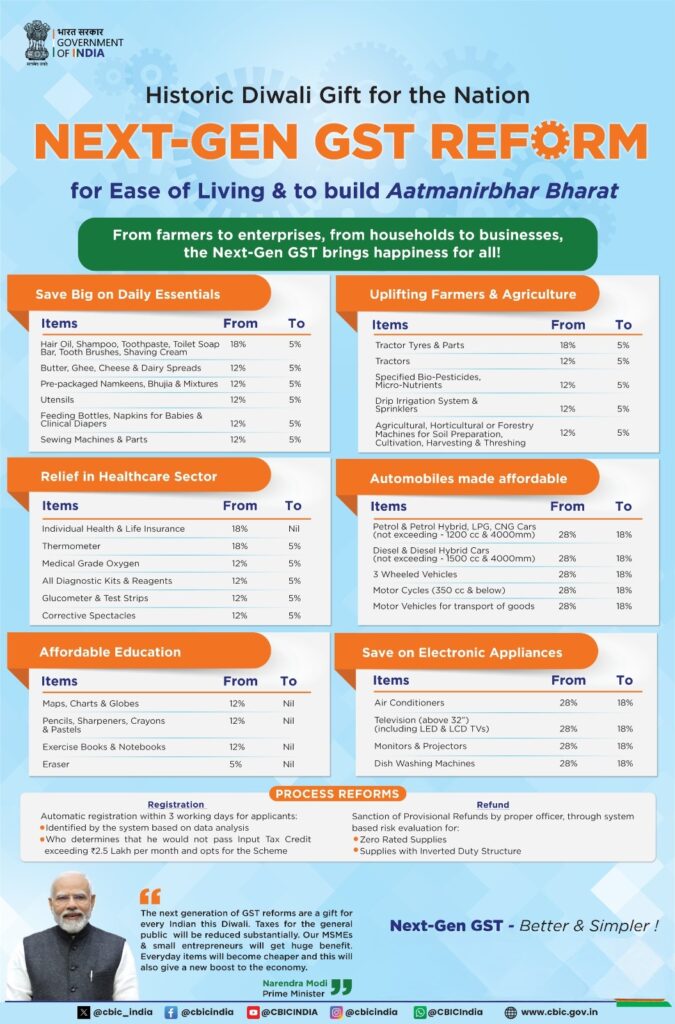
GST reduced to 5% for nearly all items previously taxed at 12%—including personal care (toothpaste, shampoo, hair oil), everyday FMCG, agricultural equipment like tractors and farm machinery, and power-saving appliances (ACs, TVs) now moved from 28% to 18% or 5% .
In particular:
Tractors and farm machinery reduced from 12% to 5% to boost rural demand and agri-productivity .
Essential personal care items such as talcum powder, toothpaste, shampoo now at 5%, down from 18% .
💊 Health & Insurance Relief
GST on 33 key medicines cut from 12% to nil.

Individual health and life insurance premiums now fully exempt from GST (0%)—a move hailed as major relief for households and policyholders .
🚗 Luxury & Sin Goods Tax Hiked to 40%
All tobacco products (cigarettes, gutka, pan masala, bidis) now taxed at 40%, up from 28% .
Carbonated and caffeinated beverages also moved into the 40% “sin-levy” slab (28% + compensation cess) .
Mid-sized and large cars (engine capacity > 1,200 cc) bumped from 28% to a new 40% GST rate, classified as luxury consumption. In contrast, compact cars and small hybrid vehicles now attract 18% GST .
🧾 Streamlined Structure & Broader Impact
The GST system has been simplified from four tax slabs (5%, 12%, 18%, 28%) to just two core rates—5% and 18%—with a special 40% sin/luxury rate for select items. This aims to reduce complexity, compliance burdens, and help boost consumption across sectors .
States are expected to absorb around ₹47,700 crore (~USD 5.8 billion) in revenue loss as consumption pick-up is anticipated to offset tax cuts over time .
Market watchers welcomed the reforms: car manufacturers, FMCG majors, and insurance companies saw upticks in investor sentiment, while rural demand and farmer income are expected to revive—with tractors and farm tools becoming more affordable .
✅ Summary Table: Key GST Rate Changes (Effective September 22, 2025)
Category Previous GST New GST
Personal care, FMCG 12–18% 5%
Tractors & farm machinery 12% 5%
Essential drugs & medicines 12% 0%
Individual health & life insurance 18% 0%
Small / hybrid cars (≤1.2 L) 28% 18%
Large/luxury cars (>1.2 L) 28% + cess 40%
Tobacco & pan masala, caffeinated drinks 28% + cess 40%
What It Means
Everyday consumers will pay less for essentials—from shampoo to tractors.
Insurance and medicines become more accessible.
Sin and luxury goods bear much higher tax, discouraging excess use and generating revenue balance.
The simplified tax bands make compliance easier for businesses and administration.